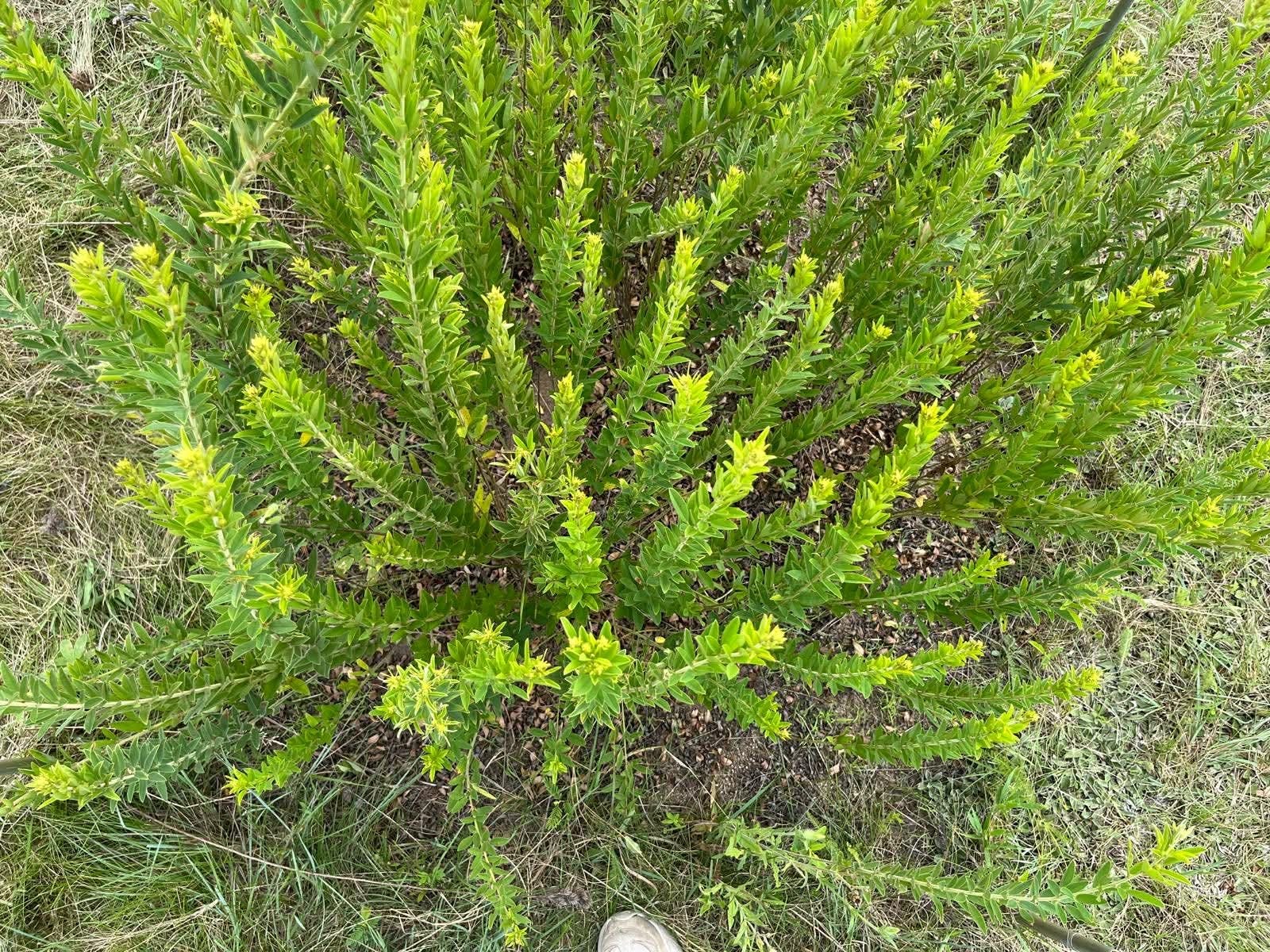
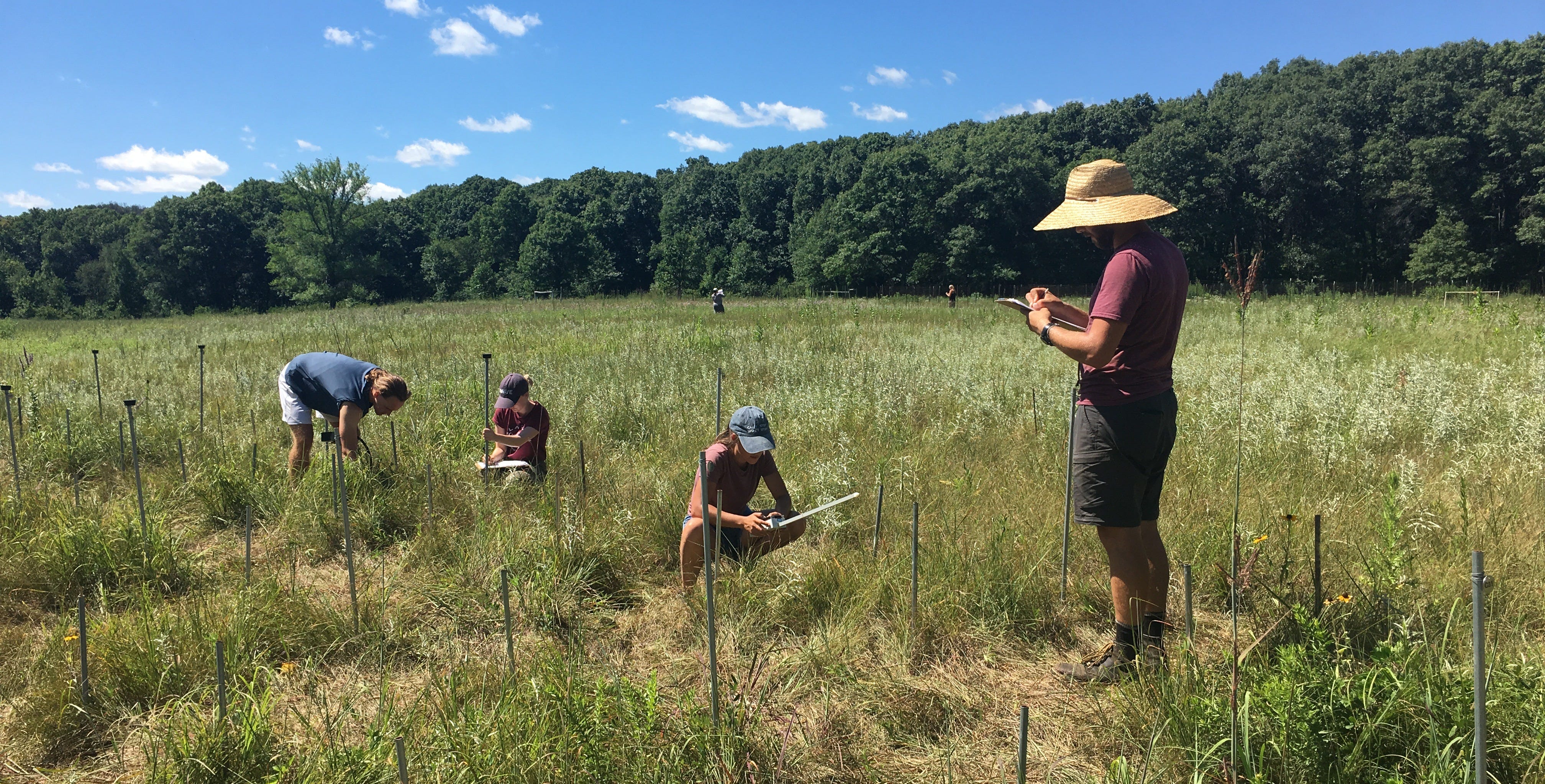
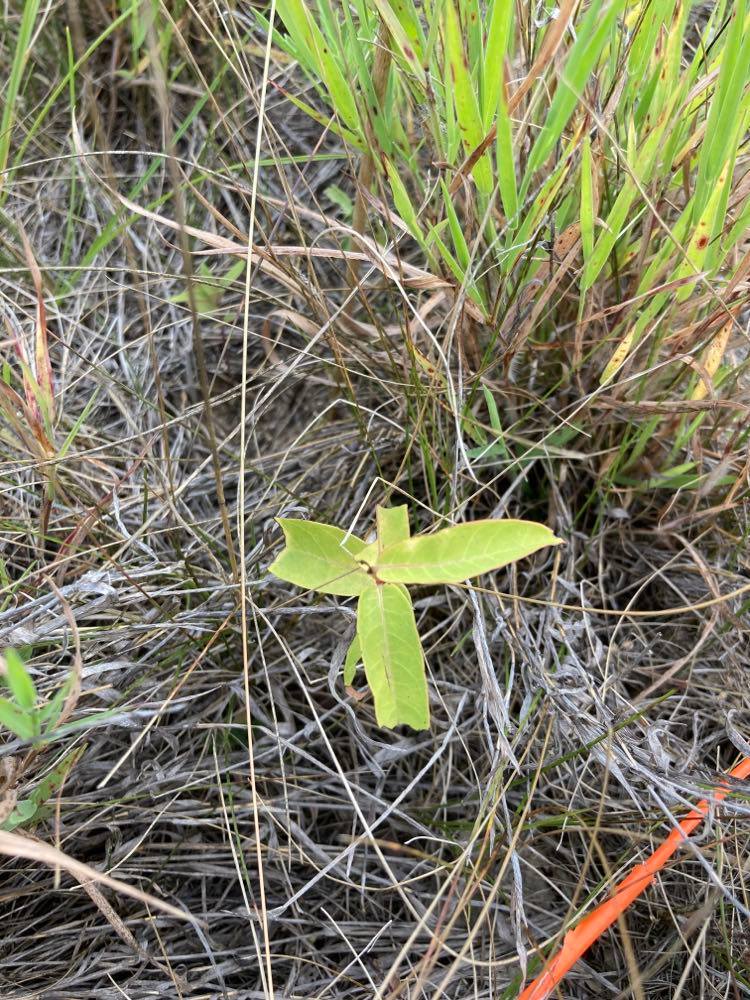
Preparations are underway for field season 2024, promising to be the biggest one yet in the project!
Both Harry and Josh will be spending 3 months over the summer at Cedar Creek Ecosystem Science Reserve conducting plant surveys, plant trait measurements along with a whole host of other sampling to undertake.
Josh will be largely be focusing on his mechanistic enemy release or “MechER” experiment, which is in its final year. The experiment examines the role of plant pathogens in regulating plant populations and whether release from these pathogens can explain the success of non-native species. The first year of results from this experiment were excitingly published in Journal of Ecology last month.
Harry will be largely focusing on a monoculture experiment set-up two years ago on the grounds of the big biodiversity experiment. In this experiment, we have planted a range of commonly found species at the field site in single-species plots that we will now use to measure a whole host of different aboveground and belowground traits. This data will be essential as we look to further develop models that can predict the impact of non-native species on native biodiversity.
Alongside these experiments, we also have our sights set on some additional data ‘goodies’, including measures of soil functioning and fungal communities across the different experiments. There will also be a resurvey of E275, an experiment set up by Jane in 2012 to explore the drivers of plant colonisation, the first results of which were published last year.
All in all it promises to be a busy but exciting summer of fieldwork!
Earlier this month, an article I wrote was published in the Conversation discussing the implications of a recently published meta-analysis highlighting the risk extreme weather events pose to native biodiversity.
Extreme weather events are predicted to increase in regularity in the coming century under human-driven climatic change, posing increasing challenges for the protection of native biodiversity. Interactions between extreme weather events and invasive species have been observed in a number of recent studies (such as in this study), and could exacerbate impacts of non-native introductions on native biodiversity.
The study, published in Nature Ecology and Evolution, examined the responses of native and non-native animals to a range of extreme weather events (such as storms, wildfires, droughts) across the globe. They found that non-native species are in general more resistant to extreme weather events, and may therefore be better placed to capitalize and out compete native biodiversity following such events.
Studies such as this highlight how interactions between non-native species and other global change drivers may combine to threaten native biodiversity in the Anthropocene, and how we may not yet be able to see the full scale of these interactions and the threats they pose. Developing predictive models, such as in WP5 of AlienImpacts, that allow forecasting of species responses under new environmental conditions and to changing climatic conditions is therefore crucial to identify areas of native biodiversity most at risk and implement preventative and restorative measures that can protect native diversity in the future.
Biological invasions are one of the five biggest threats to global biodiversity. On the face of it, this doesnโt make sense: how can exotic species with no previous history in a given location do so well and outcompete native species? The most popular hypothesis to explain this is the Enemy Release Hypothesis (ERH). This hypothesis states that exotic species leave their natural enemies behind when being introduced beyond their home range, releasing them from top-down regulation and enhancing performance in their invaded range. Despite this intuitive basis, evidence for the ERH is inconsistent. Further, while many studies demonstrate that exotic species lose enemies, they do not explicitly link this loss with increases in exotic performance. We therefore still do not understand whether enemy release can explain high exotic performance, and under what circumstances if so.
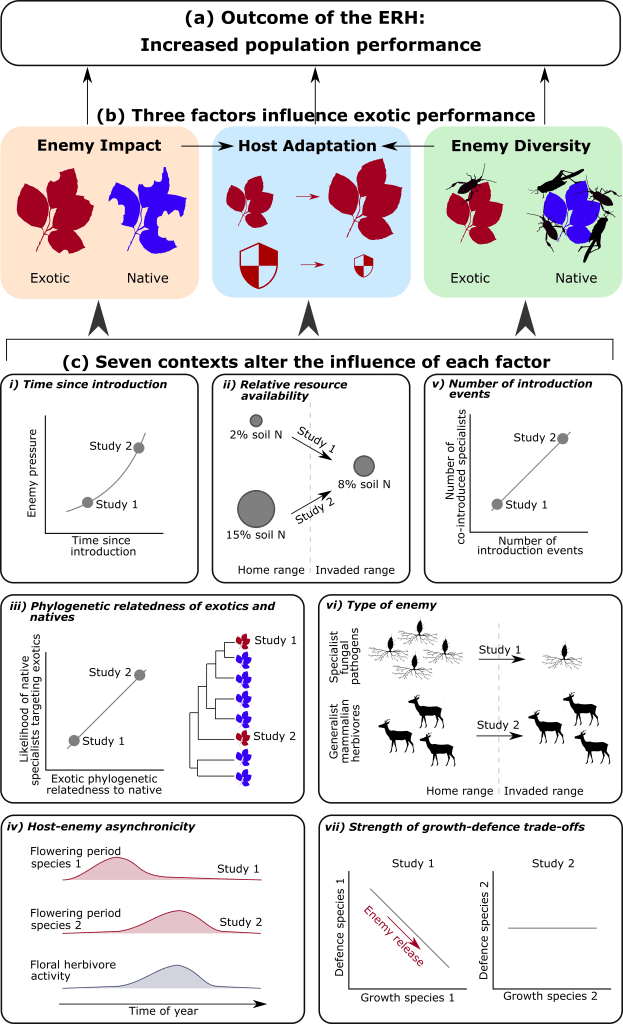
To address this, we have proposed a new framework for the ERH (Fig. 1), that has just been published in Ecology Letters. Our framework emphasises exotic performance as the key outcome of the ERH (Fig. 1a), with three factors โ enemy impact, enemy diversity, and host adaptation โ that influence performance (Fig. 1b). We then explore seven contexts that modulate the effect of these factors (Fig 1c): (i) time since introduction; (ii) resource availability; (iii) phylogenetic relatedness of exotic and native species; (iv) hostโenemy asynchronicity; (v) number of introduction events; (vi) type of enemy; and (vii) the strength of growthโdefence trade-offs.
We argue that our framework is more mechanistic and predictive, enabling better understanding of how and when enemy release can facilitate invasion. Our approach helps explain the โcontext-dependenceโ in previous support for the ERH (something which is important to grapple with!). The framework also shows that many different enemy-related invasion hypotheses just represent different factor/context combinations, bringing theoretical clarity โ we donโt need a new hypothesis for every new set of observations. We hope that our paper will encourage more explicit testing and reporting of the factors and contexts of the ERH in future studies on enemy release. This will enable effective synthesis, and more mechanistic insights into the role of enemy release in global invasions.
Figure 1: A mechanistic reframing of the enemy release hypothesis. The enemy release hypothesis as an explanation for (a) increased exotic performance is the product of (b) three factors, which are modulated by (c) seven contexts. Three factors: 1) the difference in per-capita effect of enemies (compare damage on leaves); 2) the difference in enemy diversity, which incorporates enemy abundance (number of individuals) and richness (number of species); and 3) host adaptation, which involves changes in exotic growth (plant size) and defence (shield size). The influence of these factors and our ability to detect them changes with seven contexts. Each panel in (c) shows two hypothetical studies that examine different levels of a given context, and so would give contrasting support for the ERH.
A jam-packed first half of 2023 with a host of visitors and exciting science keeping us busy!
Things kicked off with Marc Cadotte visiting the lab for a month back in March. During his time with us, Marc gave a departmental seminar at KCL, along with an interactive session exploring the use of green space in cities to the Political Ecology, Biodiversity and Ecosystem Services (PEBES) group.
Adam Clark was also able to join for a few days in April to share his research to the group and work on an ongoing meta-community modelling collaboration with Jane and Laura Graham, who could only join virtually as heavy snowfall brought midland trains to a standstill!
We were then joined by Elizabeth Borer, Eric Seabloom, and Sophia Turner along with Marc for a 2-day workshop aimed at disentangling invasive species as drivers or passengers of environmental change and biodiversity loss. The workshop was crammed full of brainstorming and discussions, but we still found time for a few dog walks and some evening meals together.
Dinner and drinks following the culmination of the AlienImpacts workshopWorkshop team out for a mid-afternoon dog walk
In mid-June we set off for our annual AlienImpacts lab retreat, this time in Ashdown Forest in East Sussex. The retreat offered a welcome break from the London heat, and a chance to reflect on the work completed over the last year and focus on areas at which we could better collaborate to achieve our scientific goals for the project. ย ย
Finally, in late June David Tilman joined us as chair of the AlienImpacts scientific advisory committee and a key collaborator in the project. Despite Dave battling jet lag, we discussed the many ongoing components of AlienImpacts and got valuable feedback on the project thus far.
All-in-all an exciting first 6 months for the team!
David Tilman (center) and members of the AlienImpacts team in June 2023The AlienImpacts team on the annual retreat
Together, we will develop a project exploring perceptions of human and plant โnativenessโ to perceive ourselves in relation to biodiversity and climate crises.
Activate from the series ‘Beyond Triffids: Plants without Prejudice’ 2023 by Lรฉonie Hampton.
Invasive alien species are recognised as one of the greatest threats to global biodiversity, their invasion facilitated by, and compounding impacts of, climate change.โฏ Within ecology and conservation biology there is a heated debate about whether alien plant invasions are good or bad for biodiversity. Do human-introduced alien species increase diversity and compensate for native species loss? Or are alien plants a major threat to biodiversity, warranting active management and restrictions on trade and travel?
Through the lens of alien plants we will particularly focus on perceptions of โnativenessโ โ both human and plant. Our interdisciplinary approach โ co-created between arts, science and humanities โ will challenge and interrogate understandings and value judgements, and how these values may need re-evaluation in light of biodiversity loss and migration.
Just as speculative fiction creates the potential, far off in space, where we might see ourselves more clearly, this creative collaboration will work with the perceptions and values of plants to perceive ourselves in relation to our urgent biodiversity and climate crisis.
Our first public outreach event through this collaboration will be held at the Thelma Hulbert Gallery in Honiton on 4 March: Climate Conversations & Honiton Seed Swap. This will take place on the final day of Lรฉonie’s exhibition “A Language of Seeds“.
The residency is funded byย King’s Cultureย and supported by our ERC projectย AlienImpacts. More about this collaboration and five others supported by King’s Culture can be foundย here.ย
Here at AlienImpacts, we are focused on predicting the impacts of plant invasions on community diversity. But we also think that sometimes it is worth taking a step back and asking some bigger questions too. What do we mean by an invasive species? Is it realistic to try and manage all invasive species? Last year, in the build-up to COP15, Marรญa รngeles and I wrote a blog for King’s College about some of these issues.
“We are currently facing a major biodiversity crisis โ something the UN Biodiversity Conference (COP15), in Canada this December, intends to address. Ecologists, Marรญa รngeles Pรฉrez-Navarro and Joshua Brian explain why it’s so difficult to manage invasive species and how this all fits in with the global summit’s goal of living in harmony with nature.”
This year the 12th International conference on biological invasions took place in Tartu (Estonia) from 12 to 16 September and AlienImpacts team couldnโt miss it! This conference is biennially organized by NEOBIOTA (the European Group on Biological Invasions) since 2000 and this time it was the turn of Estonian Naturalistsโ Society to host and organize it. This year it was the first face-to-face meeting since the pandemic, and around a hundred of people meet in the Library Conference Centre of the University of Tartu, while around other fifty people attended online.
From AlienImpactsโ team only Josh could attend in person while me and Jane had to attend virtually. However, it gave us the opportunity to live the conference in two different ways, and it was extremely well organised to combine the virtual and in-person talks. I can honestly say that it was the best hybrid format I have ever participated in. The sound and image were wonderful, the slides and the speaker were presented in two separate windows in the screen, the slides with more relevant information were enlarged when required and even the virtual speakers could see the applause of the whole room and the faces of the people who asked us questions! If one day I have to organise a hybrid conference, I will definitely ask the organisers of this congress!
The conference brought together experts and colleagues in the field of biological invasions, and it was a pleasure to listen and learn from the diversity of talks ranging from the more applied and management aspects to data collection and modelling aspects. It was a pity not to be able to spend time with them in person at the coffee breaks and see the poster sessions.
AlienImpacts contributions
Jane was the first speaker in the first day of talks after the keynote. She presented her recent study about context dependency in ecology, and she explained the differences between real and apparent context dependence, the main types, their causes, and potential solutions. It was a good opportunity to think about how often in ecology we attribute unexplained processes to context dependence as a generic entity and how possible it is to try to address it and attribute context dependence to specific causes and thus improve the conclusions of the studies.
Picture 1. Janeโs talk during Tartu conference. View from the Tartu Conference Centre. Photo taken by Josh Brian.
Later that day I presented some results of my last study addressing the Darwin Naturalization Conundrum across spatial scales. According to Darwinโs natural selection theory it can be expected that those introduced species more similar to natives are more successful in their establishment as they share accurate traits to survive in the new habitat (pre-adaptation hypothesis), but also that those introduced species more similar to the natives can be less successful due to competition with natives (limiting-similarity hypothesis). I showed that the relevance of these hypotheses varied across spatial scales for grasslands communities. It was great to share these results and discuss with colleges about it despite the distance.
Picture 2. Question from the audience during Mariaโs talk. View for virtual attendants. Screenshots taken Jane Catford. It could be appreciated how clearly could the virtual audience and speaker follow the questions from people in the room.
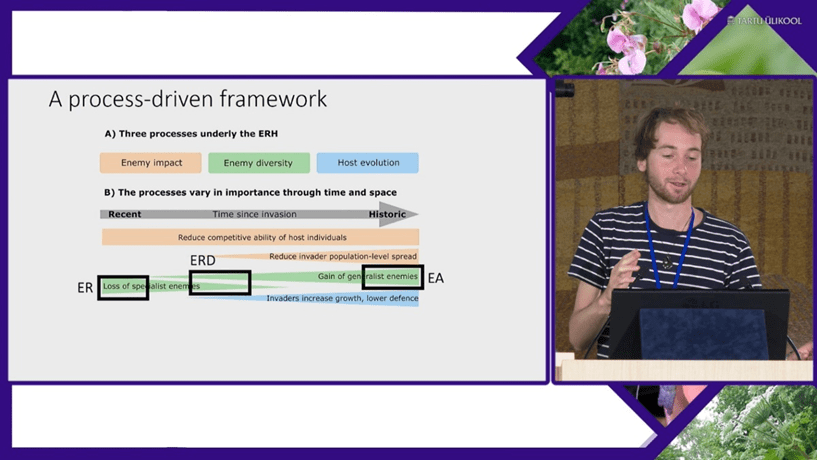
Finally, Josh presented on Wednesday 13. He talked about his recent synthesis on enemy release hypothesis. Enemy release is one of the main hypotheses explaining the success of alien species in introduced ranges, and it states that during the invasion process, invasive species lose the enemies with which they interacted in their native range, and this allows them to improve their performance and outcompete natives in the new range. He did a great job on compiling such a big number of studies and present the main findings in a simple way to the audience. He explained the different processes driving enemy release, and the relevance of different enemy release hypotheses along temporal and environmental gradients. Iโm sure he had great discussions with colleges in Tartu after that.
Picture 3 Joshโs talk during Tartu conference. View for virtual attendants. Screenshot taken by Josh Maria Perez-Navarro.
It was such a great experience to participate, we all enjoyed a lot the conference and we are looking forward to the next NEOBIOTA meeting in Lisbon in 2024!
I have just returned from three months at Cedar Creek Ecosystem Science Reserve, an amazing field station run by the University of Minnesota. I was there to set up an experiment on the enemy release hypothesis, which states that alien species succeed because they are released from their native enemies (e.g. predators, parasites and pathogens) which limit them in their native ranges. Using sixteen different grassland species as our ‘invaders’, planted into two different community contexts and hand-treated with combinations of insecticide and fungicide, we will explore the contexts (if any) under which enemy release facilitates invasion success.
When a photo opportunity presents itself in BigBio you are obliged to say yes!
The season was a busy one – everything adds up fast when you are trying to establish 288 plots, or hand-paint over 1500 seedlings with pesticide! But thanks to a great team of staff and interns at Cedar Creek, we got the experiment in the ground and some great preliminary data collected. The experiment will run for another two years, to see how enemy release affects both our target invaders, as well as the wider plant communities.
Some of our plots in the early succession community in the Lawrence strips
One of the great things about Cedar Creek is the amazing community of researchers that are there alongside you, providing plenty of people to learn from, as well as have fun with! While at Cedar Creek (which was also my first time in the USA!) I tried my first smore and about fifteen different flavours of Oreo, had a blizzard from Dairy Queen (apparently a must), helped to count bison, and played many plant-related games (I will never forget the stress of Avocado Smash). I look forward to coming back next year to see everyone again and to see the progress of the experiment – watch this space!
Harry and I ‘enjoy’ some early-morning fieldwork in the rain…
Like many ecological research projects, one of the key things we need to โ and plan to โ grapple with in AlienImpacts is context dependence. Using examples from biological invasions, in this paper we propose a way in which we can think about and tackle context dependence.
A phrase that you are bound to hear many times at any ecology conference is โit dependsโ. We see context dependence โ variation in theย magnitude or sign of ecological relationships depending on the conditions under which they are observed (Fig. 1) โย in just about every study and every system.ย Such variation, especially when unexplained, can lead to spurious or seemingly contradictory conclusions across studies, which can limit understanding and our ability to transfer findings across studies, space, and time. Because of the wide prevalence of observed context dependence and the critical need to tackle it, a group of us recently knocked heads (and read lots of fabulous papers!) about how it can be addressed. Our reading, thinking, talking, drawing and writing culminated in thisย open access paper in TREE.ย
Figure 1: Context dependence may be invoked when the observed relationship between two variables varies in (a) magnitude (strength), (b) signโฆ